How to Build a Scalable Tech Startup from Scratch: A Founder's Roadmap
Most tech startups don't fail because the founders lacked ambition. They fail because the foundations were wrong — a product nobody needed, a tech stack that couldn't grow, or a team assembled in the wrong order. Building a scalable technology company requires making the right decisions early, in the right sequence. This guide walks through each stage with the specificity that first-time founders actually need.
Start with the Problem, Not the Product
Before writing a single line of code, your job is to understand a problem deeply enough that you can describe it better than the people experiencing it. That's the real starting point for any scalable tech startup.
Founders who skip this step build products that are technically impressive but commercially irrelevant. The discipline here is deliberate: talk to 20–30 potential users before you design anything. Not to pitch them, but to listen. You're looking for a problem that is frequent, painful, and currently solved with a workaround — a spreadsheet, a manual process, or an expensive consultant.
The questions worth asking: How often does this problem occur? What does it cost them today — in time, money, or risk? Have they tried to fix it before? Why did that solution fall short?
When you can answer those questions with specifics, you have the raw material for a product that people will actually pay for. Everything else — the architecture, the pitch deck, the hiring plan — comes after this.
Define Your MVP and Validate Product-Market Fit Early
An MVP (Minimum Viable Product) is the smallest version of your product that lets you test your core assumption with real users. It is not a prototype, and it is not a beta — it is a deliberate experiment designed to generate evidence.
Scope your MVP ruthlessly. List every feature you think the product needs, then cut it in half. The goal is to answer one question: will people use this, and will they pay for it? A landing page with a waitlist, a manual backend, or even a concierge service can serve as an MVP before you build anything automated.
Product-market fit is the point where a meaningful segment of users finds your product indispensable. The clearest signal is retention: users come back without being prompted, and they tell others. Sean Ellis's benchmark — asking users "how would you feel if you could no longer use this product?" and targeting 40%+ responding "very disappointed" — remains one of the most practical early-stage tests available.
Resist the urge to scale before you hit this signal. Pouring growth budget into a product that hasn't found its market just accelerates the burn rate without improving the outcome.
Choose a Tech Stack Built for Growth
Your early architectural choices will either compound in your favor or create scaling debt that costs you months of engineering time later. The goal at this stage is not to build the most sophisticated system — it's to build one that can grow without being rebuilt from scratch.
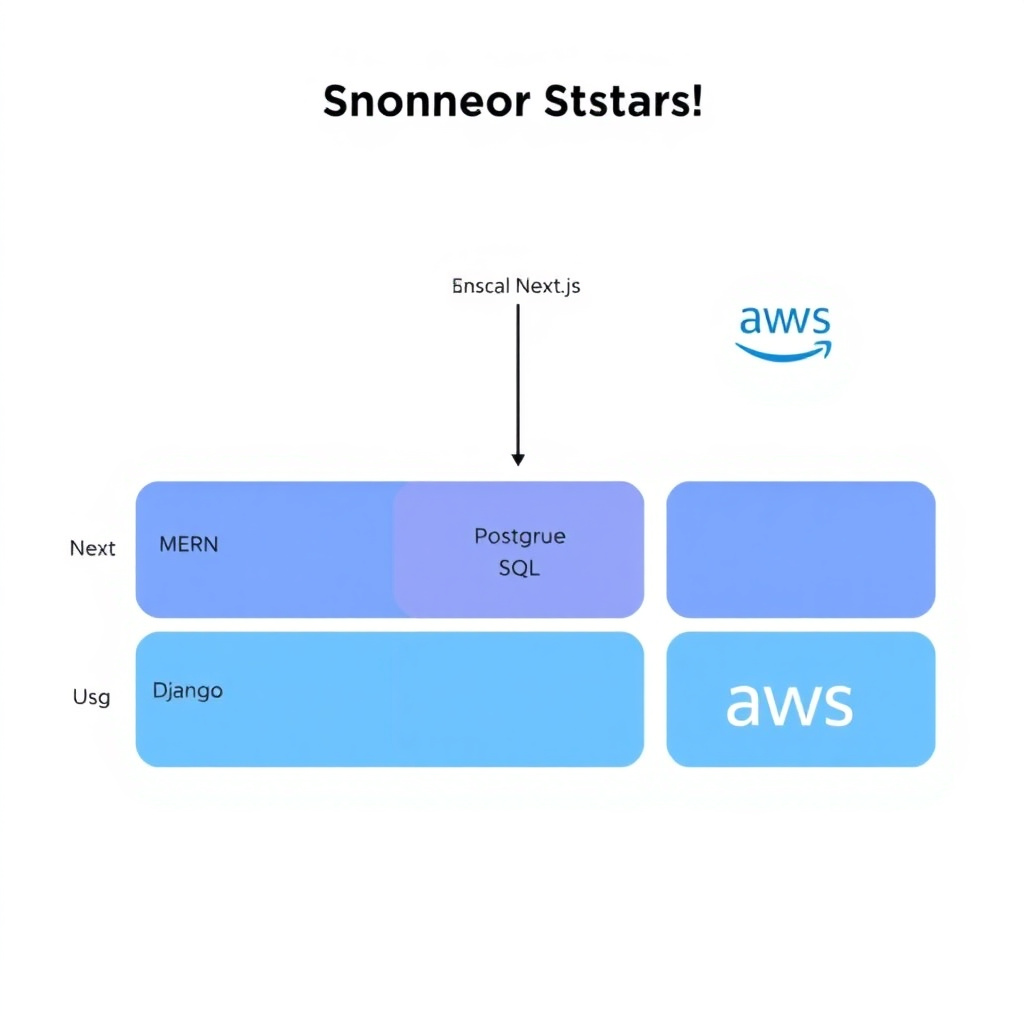
Three principles matter most here. First, go cloud-native from day one. AWS, Google Cloud, and Azure all offer managed services that handle infrastructure scaling automatically — you pay for what you use and avoid the overhead of managing servers. Second, design with an API-first approach. When your core logic is exposed through clean APIs, you can swap out front-ends, integrate third-party tools, and build mobile clients without touching the underlying system. Third, favor modular design over a monolith — not necessarily microservices on day one, but code organized so that components can be separated later without a full rewrite.
The honest trade-off: a more modular, cloud-native architecture takes longer to set up initially. For a two-person team racing to validate an MVP, a well-structured monolith on a managed platform is often the right call. The mistake is building a tightly coupled system with no migration path and then being surprised when it can't handle 10x the load.
Agile development methodology fits naturally here. Short sprints, continuous integration, and automated testing aren't bureaucratic overhead — they're the habits that let a small team move fast without accumulating technical debt that stalls growth later.
Build the Right Founding Team
The founding team is the single variable investors scrutinize most at the early stage, and for good reason: it determines execution speed, culture, and the ability to adapt when the original plan doesn't survive contact with the market.
A functional early-stage tech startup typically needs three capabilities covered: someone who can build the product (technical co-founder or lead engineer), someone who can sell and talk to customers (commercial co-founder or founder-led sales), and someone who can manage operations and keep the company from breaking as it grows. These don't have to be three separate people, but all three functions need an owner.
Hiring your first engineer is a decision that deserves more care than most founders give it. The first engineer sets the technical culture. Prioritize someone who has built production systems before, communicates clearly, and is comfortable with ambiguity — not just someone with an impressive resume from a large company where they owned one small component of a massive codebase.
Team composition also affects investor confidence directly. A solo technical founder with no commercial experience, or a business-only founding team with no in-house engineering, both raise flags. Investors are betting on the team's ability to execute through uncertainty — gaps in the founding team signal execution risk.
Structure Your Business for Scalability
Scalability isn't just a technical problem — it's an organizational one. Companies that grow fast without building operational foundations tend to break in predictable ways: decisions slow down, onboarding new hires takes months, and institutional knowledge lives only in the heads of the original team.
The habits that prevent this are unglamorous but high-leverage. Document decisions as you make them — not in exhaustive wikis, but in short records of what you decided and why. Use asynchronous communication tools so that context is searchable and new team members can get up to speed without scheduling a dozen meetings. Define processes before you need them, not after the chaos has already started.
Unit economics deserve attention here too. Know your burn rate — how much cash you spend each month — and track the metrics that predict whether the business model works at scale: customer acquisition cost (CAC), lifetime value (LTV), and gross margin. A startup that grows revenue 3x but sees its CAC grow 5x is not scaling — it's accelerating toward a cliff.
Navigate Funding Without Losing Focus
The main funding paths for a tech startup are bootstrapping (self-funded, revenue-driven growth), seed funding (early-stage investors, typically $500K–$3M), and Series A (institutional venture capital, typically $5M–$15M, requiring demonstrated traction). Each path has different implications for how fast you can move and what you give up.
Bootstrapping preserves equity and forces revenue discipline, but limits how fast you can hire and build. Raising seed capital accelerates the timeline but introduces investor expectations and dilution. Neither is universally better — the right choice depends on your market, your competitive dynamics, and your personal risk tolerance.
When you do raise, investors at the seed stage are primarily evaluating three things: the size of the problem you're solving, the quality of the founding team, and early evidence of traction. Traction metrics at this stage don't have to be revenue — they can be active users, retention rates, letters of intent from enterprise customers, or a waitlist with strong conversion signals. What investors want to see is evidence that the market is responding.
One discipline that separates founders who raise successfully from those who don't: they know their numbers cold. Burn rate, runway, CAC, LTV, monthly active users — these should be on the tip of your tongue before you walk into any investor pitch.
Launch, Measure, and Iterate
A go-to-market strategy for an early-stage tech startup should be narrow, not broad. Pick one customer segment, one acquisition channel, and one core use case — and go deep before you go wide.
The launch itself matters less than most founders think. A quiet launch to 50 highly targeted users who match your ideal customer profile will teach you more than a splashy Product Hunt launch to thousands of people who aren't your customer. What you're optimizing for at launch is learning speed, not vanity metrics.
Define your traction metrics before you launch, not after. For a B2B SaaS product, that might be weekly active users, trial-to-paid conversion rate, and net revenue retention. For a consumer app, it might be day-7 and day-30 retention. The specific metrics matter less than the discipline of tracking them consistently and letting the data drive prioritization decisions.
Iteration is where most of the real work happens. Each sprint should answer a specific question about the product or the market. When the data contradicts your assumptions — and it will — treat that as the most valuable output of the sprint, not a failure. The startups that scale are the ones that iterate faster than their competitors, not the ones that got the product right on the first try.
Frequently Asked Questions
How much money do you need to start a tech startup?
The honest answer is: less than most people assume, and more than most people plan for. A two-person team building a software product can get to an MVP for $20,000–$50,000 if they're technical and lean. The bigger risk isn't the initial build cost — it's underestimating the runway needed to reach product-market fit, which typically takes 12–24 months.
When should a startup hire its first engineer?
If neither founder is technical, hire your first engineer as early as possible — ideally as a co-founder rather than an employee. If one founder is technical, the first engineering hire should come when the product has validated demand and the technical co-founder is spending more time on management than on building. Hiring too early burns runway; hiring too late creates a bottleneck that slows everything else down.
What is the difference between scaling a product and scaling a business?
Scaling a product means the technical infrastructure handles more users without degrading performance. Scaling a business means the unit economics improve as you grow — acquiring customers gets cheaper, margins expand, and operational processes don't require proportional headcount increases. You need both, but they require different investments and different expertise.
How do you know when you have achieved product-market fit?
The clearest signals are behavioral, not attitudinal. Users return without prompting, churn drops below a threshold that varies by category (under 2% monthly for B2B SaaS is a reasonable benchmark), and organic referrals start driving a meaningful share of new signups. When users are disappointed at the idea of losing access to your product, you're close. When they're actively recruiting others to use it, you're there.
What are the most common reasons tech startups fail to scale?
The most frequent causes are: building before validating the problem, choosing a tech stack that creates scaling debt, hiring too fast before the business model is proven, and running out of runway while still searching for product-market fit. The underlying pattern in most failures is moving to the next stage before the current stage is solid — scaling distribution before the product retains users, or raising a Series A before seed-stage metrics justify the valuation.