Startupmonkeys

Essential Tech Stacks for Early-Stage Startups: What to Choose and Why It Matters

Choosing a tech stack feels like a technical decision. It isn't. It's a business decision that shapes how fast you ship, who you can hire, and how much runway you burn before finding product-market fit. Get it wrong and you're refactoring code when you should be talking to customers.

Why Your Tech Stack Decision Is a Business Decision

Your stack choice directly affects hiring speed, infrastructure cost, and developer velocity — three variables that determine whether an early-stage startup survives its first year. A framework with a small talent pool means longer hiring cycles and higher salaries. A complex architecture means slower iteration.

Consider two founders building similar SaaS products. One picks a well-documented, widely adopted stack and ships an MVP in six weeks. The other chooses a cutting-edge but niche runtime, spends three weeks debugging sparse documentation, and misses their launch window. The technology itself wasn't the problem — the choice was.

For bootstrapped startups, this calculus is even sharper. Every week of delayed shipping is a week of zero revenue. Funded startups have more buffer, but burning capital on avoidable technical complexity is still a poor use of investor money. The stack should serve the business, not the other way around.

The Core Components of a Startup Tech Stack

A startup tech stack has four layers, and you need a deliberate choice at each one: frontend, backend, database, and hosting. Understanding what each layer does — and what you're trading off — is the foundation of any good decision.

  • Frontend framework: What users see and interact with. React dominates the market, with Next.js adding server-side rendering and routing on top. Vue is a lighter alternative with a gentler learning curve.
  • Backend runtime/framework: The logic layer. Node.js keeps the language consistent if your frontend is JavaScript. Python with Django offers rapid development and a massive ecosystem. Ruby on Rails remains a strong choice for teams that prioritize convention over configuration.
  • Database: Where your data lives. PostgreSQL is the default choice for relational data — reliable, well-supported, and scales further than most startups will ever need. MongoDB suits document-heavy or schema-flexible use cases. Firebase works well for real-time apps and teams that want to skip backend setup entirely in early stages.
  • Cloud infrastructure and hosting: Where everything runs. Vercel is purpose-built for Next.js deployments and removes most DevOps friction. Railway simplifies backend and database hosting for small teams. AWS and GCP offer more control but require more configuration — usually overkill before Series A.

The goal at the MVP stage isn't to pick the most powerful option at each layer. It's to pick the combination that lets a small team move fast without creating a maintenance nightmare six months later.

Most Common and Proven Stack Combinations

Three stack combinations have proven themselves across hundreds of early-stage startups. Each has a clear use case, real trade-offs, and a large enough talent pool to hire from.

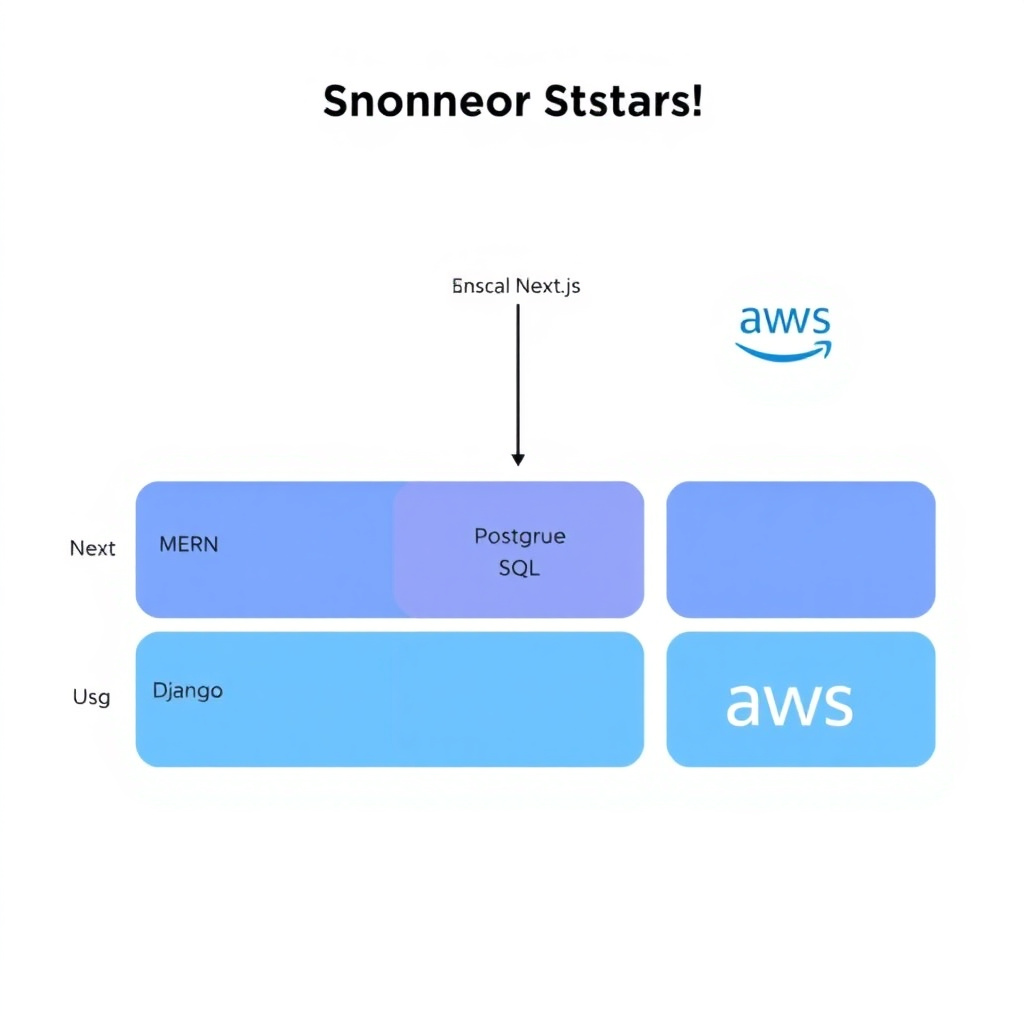
MERN Stack (MongoDB, Express, React, Node.js)

MERN is a full-JavaScript stack, which means one language across the entire codebase. For small teams — especially those with one or two generalist engineers — this reduces context switching and simplifies onboarding. MongoDB's flexible schema is useful when your data model is still evolving. The trade-off: MongoDB's lack of strict relational constraints can create data integrity issues as the product matures, and you'll likely migrate to a relational database eventually.

Next.js + PostgreSQL + Vercel

This combination has become the default for modern SaaS products. Next.js handles both frontend rendering and lightweight API routes, PostgreSQL provides a rock-solid relational database, and Vercel deploys the whole thing with near-zero configuration. Developer velocity on this stack is exceptionally high for web-first products. The limitation is that Vercel's pricing scales quickly under heavy traffic, and PostgreSQL requires more upfront schema thinking than document databases.

Python + Django + AWS

Django's "batteries included" philosophy means authentication, admin panels, ORM, and form handling come out of the box. For data-heavy products, AI-adjacent tools, or founders with a Python background, this stack is hard to beat. AWS adds flexibility and long-term scalability. The cost: AWS has a steep learning curve, and Django's opinionated structure can feel constraining for products that don't fit its conventions.

How to Match Your Stack to Your Team and Product Type

The best stack for your startup is the one your team already knows. Switching to an unfamiliar technology to chase performance gains you don't yet need is one of the most common and costly mistakes early teams make.

Start with your team's existing skills. If your lead engineer has shipped three Django apps, don't introduce Next.js because it's trending on Hacker News. The productivity loss during ramp-up will cost more than any theoretical advantage.

Product type matters too. A few rough guidelines:

  • SaaS web app: Next.js + PostgreSQL + Vercel is the current default. Fast to build, easy to deploy, strong hiring pool.
  • Marketplace or platform: Django or Rails handle complex business logic well. PostgreSQL's relational model fits marketplace data structures cleanly.
  • API-first or developer tool: Node.js or Python FastAPI, with PostgreSQL. Prioritize clean API design over frontend complexity.
  • Real-time app (chat, collaboration): Firebase or Supabase can accelerate early development significantly. Plan for migration if you hit scale.

Team size is the other variable. A solo founder needs a stack they can operate end-to-end. A team of four can afford slightly more specialization. But even then, keeping the stack simple enough that any engineer can touch any part of the codebase is worth more than architectural elegance.

What to Avoid: Common Stack Mistakes Early Startups Make

Most early-stage stack mistakes fall into a few predictable patterns. Recognizing them before you commit saves weeks of rework.

Over-engineering from day one. Microservices, Kubernetes, and event-driven architectures are solutions to problems you don't have yet. A monolith is faster to build, easier to debug, and simpler to deploy. Airbnb, Shopify, and GitHub all started as monoliths. The argument for microservices at the MVP stage is almost always premature. Start with a well-structured monolith and extract services when a specific bottleneck demands it.

Choosing niche tools that shrink the hiring pool. A framework with 50,000 GitHub stars sounds exciting. But if there are only 200 developers in your city who know it, your next hire will take four months and cost 30% more. Mainstream tools — React, Node.js, Python, PostgreSQL — have deep talent pools and abundant documentation. That's not a coincidence; it's a compounding advantage.

Accumulating technical debt silently. Shortcuts taken during MVP development are fine — if you track them. The mistake is treating MVP code as production-ready without a plan to address the debt. A simple internal doc listing known shortcuts and their intended resolution timeline costs nothing and prevents the "we can't add features because the codebase is a mess" conversation six months later.

Ignoring infrastructure costs until they're painful. Firebase and Vercel are excellent for early development, but their pricing models can surprise you at scale. Before committing to a managed service, spend 20 minutes modeling what your bill looks like at 10x your current usage. It's not a reason to avoid these tools — it's a reason to know your exit ramp.

Scaling Considerations: When to Revisit Your Stack

Your MVP stack doesn't need to last forever — and it probably won't. The goal is to get to meaningful traction, not to build infrastructure that handles a million users before you have ten.

Most startups don't need to revisit their stack until they hit one of a few specific growth milestones: sustained traffic that strains a shared hosting environment, a team large enough that a monolith creates deployment bottlenecks, or a product pivot that fundamentally changes the data model.

The transition from Firebase to PostgreSQL, or from a monolith to a service-oriented architecture, is a known engineering project with well-documented patterns. It's not a crisis — it's a sign that the product worked. Treating it as a future problem rather than a present one is the right call for most early-stage teams.

What does warrant early attention is technical debt that compounds. If your authentication layer is held together with workarounds, or your database schema has no migration strategy, those issues get harder to fix as the codebase grows. Address structural problems early; defer performance optimization until you have real data on where the bottlenecks actually are.

Quick Decision Framework for Choosing Your Stack

If you're still unsure after reading this far, run through these five questions. Your answers will narrow the field quickly.

  • What does your team already know? Default to existing skills unless there's a compelling reason not to.
  • What type of product are you building? Web SaaS, marketplace, API tool, and real-time apps each have natural stack fits.
  • How fast do you need to ship? If you need an MVP in four weeks, choose the most familiar and well-documented option available.
  • What's your hiring plan for the next 12 months? If you'll need to hire, choose a stack with a large talent pool in your market.
  • What does your infrastructure budget look like? Managed services reduce DevOps overhead but cost more at scale. Self-hosted options are cheaper long-term but require more expertise.

If you answer these honestly, the right stack usually becomes obvious. The goal isn't to find the perfect answer — it's to make a defensible decision and start building.

Frequently Asked Questions

What is the best tech stack for a startup with no technical co-founder?

No-code tools like Bubble or Webflow can get a non-technical founder to a working prototype quickly. For anything requiring custom logic or long-term scalability, hiring a contractor to build on a mainstream stack (Next.js + PostgreSQL is a safe default) is better than learning to code from scratch under time pressure.

Should early-stage startups use microservices or a monolith?

Start with a monolith. Microservices introduce operational complexity — separate deployments, inter-service communication, distributed tracing — that slows down small teams significantly. The monolithic architecture is easier to build, test, and debug at early scale. Migrate to services when a specific component genuinely needs independent scaling.

How much does tech stack choice affect fundraising or investor perception?

Less than founders think. Most early-stage investors care about traction, team, and market size — not whether you chose React or Vue. The exception is deep-tech or infrastructure startups where the technical approach is the product. For most SaaS or consumer apps, stack choice is a footnote in due diligence.

When is it worth switching stacks after launch?

Switching stacks is expensive — plan for 2-4 months of reduced feature velocity during a major migration. It's worth it when a specific technical limitation is directly blocking growth, not when the current stack is merely imperfect. "We could do this better in a different language" is rarely sufficient justification.

Is it better to use a no-code tool or a traditional stack for an MVP?

It depends on what you're validating. No-code tools are excellent for testing whether a problem is worth solving — they're fast, cheap, and require no engineering. A traditional stack is better when the technical implementation itself is part of the value proposition, or when you expect to need custom integrations quickly. Many successful startups have used both: no-code to validate, then a rebuild once the model was proven.

{{HOMEPAGE_LINKS}}